Saving Bees Through Technology

The Open Apiary Project is building the world's most comprehensive apiary health database — deploying precision sensor networks to beekeepers at no cost to combat Colony Collapse Disorder.
Colony Collapse Disorder is Accelerating

Beekeepers in the United States lose an average of 40–50% of their managed colonies every year. Without intervention, the pollinators responsible for one-third of our food supply face an existential threat.

48%Annual Colony Loss
$15BUS Crop Value at Risk
1/3Food Supply Depends on Bees
80%Losses Go Undetected

Precision Technology for Every Beekeeper

By distributing advanced, LoRa-enabled sensor networks to regional beekeepers at no cost, we will build the world's most comprehensive, anonymized apiary health database — empowering the agricultural sector to forecast swarming, detect Varroa blooms, and track climate-driven stressors in real-time.

📡

Free Sensor Deployments

Advanced LoRa-enabled sensor kits distributed to beekeepers at no cost. Each kit monitors temperature, humidity, barometric pressure, 10-band acoustics, 6-band vibration, air quality (IAQ, eCO₂, bVOC), and hive tilt — 17 metrics every 60 seconds.

🧠

AI-Powered Analysis

Daily AI health reports fuse sensor telemetry with peer-reviewed bee science research and voice-transcribed field inspections. Beekeepers receive actionable colony health scores, issue detection, and recommended interventions — automatically.

🌍

Anonymized National Database

All data is anonymized before aggregation — GPS coarsened to USDA hardiness zones, user IDs hashed, timestamps smoothed. The resulting database enables regional disease outbreak detection, climate correlation studies, and national pollination forecasting.

From Hive to Insight

Our end-to-end system transforms raw environmental data into actionable intelligence — automatically, continuously, and non-invasively.

01 📦

Deploy

Battery-powered sensor nodes install inside hives in seconds. An always-on gateway bridges the apiary to the cloud. Zero configuration required — devices auto-pair via proximity.

02 📊

Sense

Every 60 seconds, each node captures temperature, humidity, pressure, acoustic spectra, vibration spectra, air quality, and orientation — transmitting encrypted data over sub-GHz LoRa radio.

03 🧠

Analyze

Cloud-based AI fuses 24-hour telemetry with bee science research and field inspection notes to produce daily health scores, issue detection, and recommended actions for each colony.

04 🌐

Aggregate

Anonymized data feeds regional and national health indices — enabling early detection of disease outbreaks, climate impact tracking, and pollination capacity forecasting across hardiness zones.

What the Data Enables

The aggregated, anonymized database will empower researchers, regulators, and the agricultural sector with unprecedented visibility into pollinator health.

  • Forecast swarming events days before they occur using acoustic spectral signatures
  • Detect Varroa mite blooms through vibration pattern anomalies and grooming behavior markers
  • Track climate-driven stressors in real-time across USDA Plant Hardiness Zones
  • Identify regional disease outbreaks (AFB, Nosema) via correlated VOC and temperature anomalies
  • Estimate pollination capacity through aggregated waggle dance activity levels
  • Provide state apiary inspectors with data-driven colony loss tracking
  • Support USDA/EPA bee census and Colony Collapse Disorder research
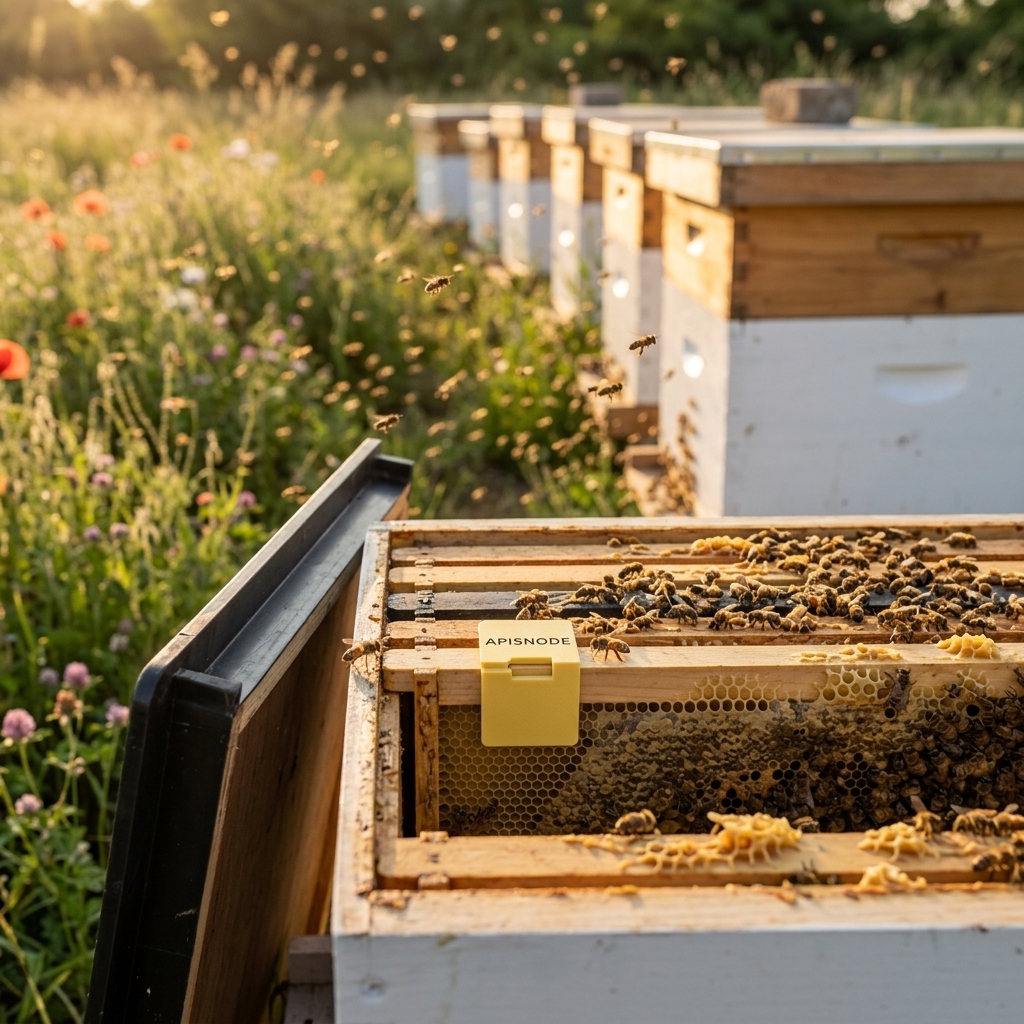
Sensor deployment in apiary

Production sensor deployment in a Colorado apiary

From Prototype to National Deployment

We've successfully engineered a V1 prototype deployed across production apiaries. Now we're transitioning to a scalable, grant-funded national deployment.

Completed — V1 Prototype

Full-Stack System Engineering

Custom PCB design, embedded firmware, cloud infrastructure, AI analytics pipeline, mobile app, and web dashboards — all built and deployed in production apiaries with over-the-air updates.

Completed — Field Validation

Production Deployment & Iteration

Months of continuous field operation validating sensor accuracy, battery life, LoRa range, deep-sleep reliability, and AI analysis quality with real colonies across multiple seasons.

In Progress — 501(c)(3) Formation

Non-Profit Establishment

Filing for 501(c)(3) status to enable tax-deductible donations, grant eligibility, and institutional partnerships with universities and agricultural agencies.

Next — Grant Applications

Funding for National Scale

Applying for USDA SBIR/STTR, NSF, EPA, and private foundation grants to fund manufacturing, distribution, and regional beekeeper onboarding across all 50 states.

Future — V2 Hardware

Scalable Manufacturing

Design for Manufacturing (DFM) optimization, injection-molded enclosures, pick-and-place PCB assembly, and streamlined provisioning for thousand-unit production runs.

Help Us Save the Bees

Whether you're a beekeeper, researcher, engineer, or conservationist — there's a role for you in the Open Apiary Project.

Contact Us
🐝

Beekeepers

Receive free sensor kits and contribute anonymized data to the national database

🔬

Researchers

Access anonymized datasets for pollinator health studies and CCD research

💰

Donors & Grants

Fund the manufacturing and deployment of sensor networks nationwide

🤝

Partners

Agricultural agencies, universities, and conservation organizations